
You find a wine you love. Then you discover there are only a few hundred cases, it isn’t widely available in stores, and the winery is offering it directly to a select group of customers.
That’s where the world of wine allocations begins.
For small-production wineries, an allocation is more than a way to sell scarce bottles. It is a way to give returning customers priority access to wines that may never enter broad distribution: single-vineyard bottlings, barrel selections, library vintages, large formats and other limited releases.
But an allocation is not exactly the same thing as a traditional wine club. Understanding the difference helps explain why some wineries use both models, and why a limited-production estate may reserve certain wines for its closest community.
What Is a Wine Allocation?
A wine allocation is a controlled release of a limited quantity of wine to a defined group of customers.
Instead of putting every bottle into general retail or open online sales, a winery may reserve a portion for customers who have joined its mailing list, membership program or allocation list.
The structure varies from winery to winery. Some producers assign a specific number of bottles to each member. Others allow customers to request wines or customize their selections. Some release allocations for a limited period before offering remaining inventory more broadly.
The common idea is simple:
A finite wine is offered first to a defined group of customers who want ongoing access to the estate.
Wine Allocation vs. Wine Club: What’s the Difference?
The terms are often used interchangeably, but they describe different ideas.
A traditional wine club generally revolves around recurring shipments. The winery chooses a schedule, members receive wine several times a year, and benefits may include discounts, complimentary tastings, and invitations to events.
An allocation is more focused on access to limited wines.
A winery can operate a wine club without allocating scarce wines, and it can use allocation-style releases within a broader membership program.
At Ambar Estate, the Ambar Circle combines both ideas. Members receive scheduled shipments twice a year, while limited-release wines are reserved exclusively for membership. Current membership levels range from four to twelve bottles per shipment, with increasing customization and access to special releases at higher tiers.
Why Do Wineries Allocate Limited Wines?
The most obvious reason is simple: there may not be enough wine for everyone.
A small estate can spend an entire growing season managing individual vineyard blocks, selecting fruit by hand and making careful decisions in the cellar, only to end up with a relatively small number of finished bottles.
That scarcity can make an allocation useful.
1. It Gives Existing Customers Priority Access
When a wine is produced in limited quantities, a winery may want the people who have followed the estate over several vintages to have the first opportunity to buy it.
This is particularly relevant for wines that have a loyal following or are produced in very small quantities.
2. It Creates Room for Highly Specific Wines
Not every wine needs to be made for the broadest possible audience.
A barrel selection, single-block wine or library release can be made around a particular site, vintage or winemaking decision rather than around a requirement to produce large quantities.
That is one reason allocation systems are common among small-production estates.
3. It Builds a Longer-Term Relationship
The value of membership is not limited to receiving bottles.
For many wineries, the relationship extends to vineyard visits, release events, tasting experiences, conversations with the winemaking team and opportunities to follow new vintages over time.
Current industry research also points toward this relationship-driven side of direct-to-consumer wine. SVB’s 2026 report describes an increasingly differentiated DTC market and emphasizes customer relationships, customization and experience as important areas for winery performance.
What Wines Are Usually Allocated?
There is no single rule, but allocations often make the most sense for wines with limited inventory or a particularly specific identity.
These can include:
Single-vineyard wines — made from fruit from one defined site.
Block-specific wines — produced from a particular section of an estate.
Barrel selections — smaller blends selected for distinctive structure, texture or longevity.
Library wines — older vintages released after additional cellar aging.
Large formats — magnums and other formats produced in much smaller quantities.
Experimental or special releases — wines made in quantities too small for broad distribution.
The important distinction is that allocation describes how the wine is offered, not automatically how good the wine is.
A wine is not necessarily better because it is allocated. Its quality still depends on the vineyard, vintage, farming, winemaking and the decisions made throughout the process.
How Does a Wine Allocation Work?
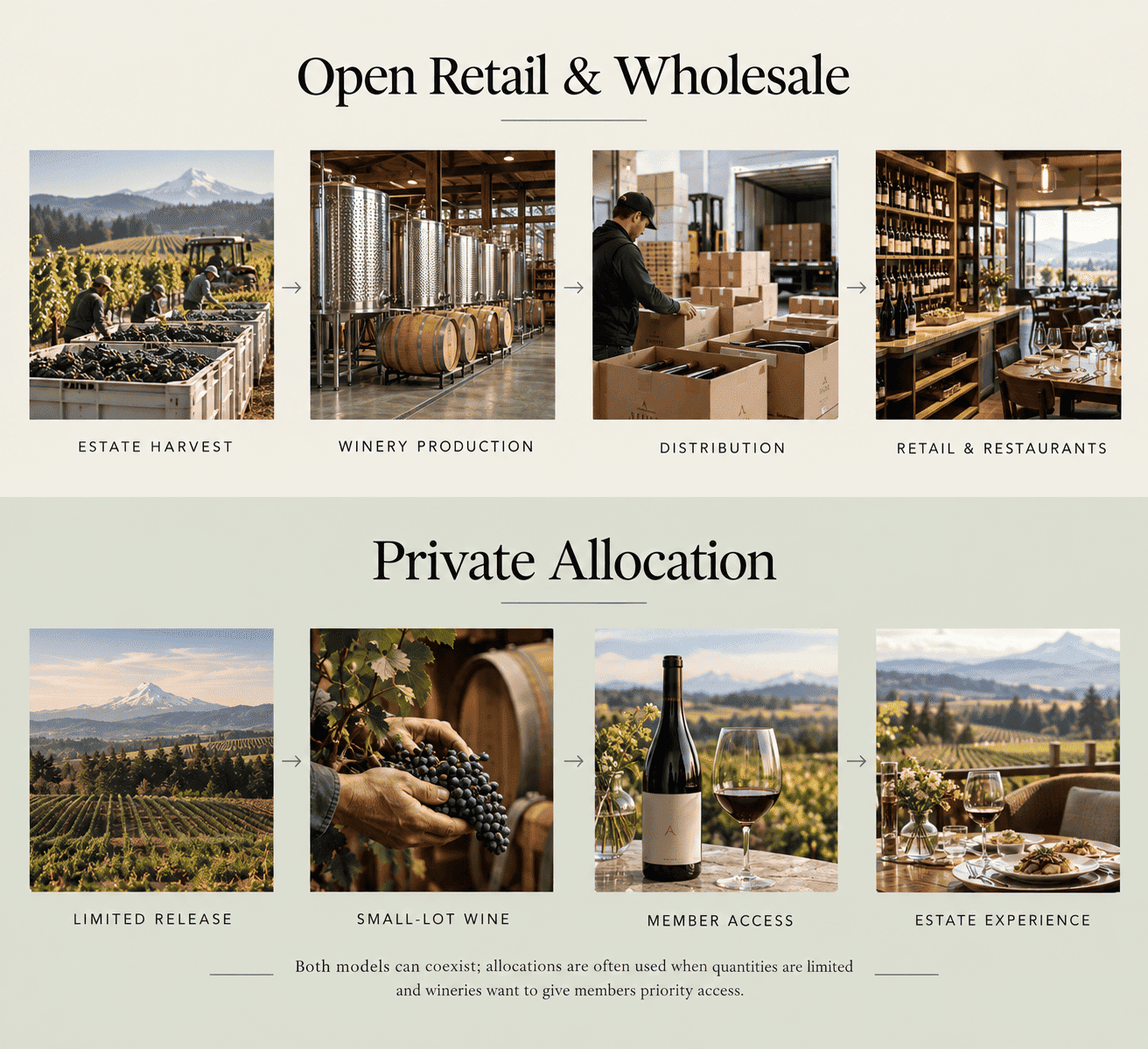
Although every winery has its own approach, the process usually follows a few basic steps.
Step 1: The Winery Determines Available Inventory
After production is complete, the estate knows how much wine is available for a particular release.
Step 2: Limited Wines Are Identified
Certain bottlings may be reserved for members, mailing-list customers, or other priority groups.
Step 3: Members Receive Their Release
The winery communicates which wines are available and how many bottles each customer can purchase.
Step 4: Customers Customize or Accept Their Allocation
Some programs are curated. Others allow partial or full customization.
Step 5: Remaining Inventory May Be Offered More Broadly
Depending on the producer and the size of the release, any remaining bottles may eventually become available through the winery’s online shop, tasting room, restaurants, or selected retail partners.
This hybrid approach is increasingly relevant as wineries rethink how they connect direct sales, membership and broader customer access. Wine Enthusiast’s 2026 reporting on wine clubs highlights several different approaches, from private allocations to flexible memberships and open e-commerce, rather than a single industry-wide model.
Why Allocation Matters at an Estate Like Ambar
At Ambar Estate, the connection between the vineyard and the bottle begins long before a wine is released.
The estate is located in the Dundee Hills on primarily Jory volcanic clay and ranges from approximately 420 to 550 feet in elevation. Ambar minimizes tillage, plants diverse cover crops, avoids pesticides, herbicides, and synthetic fertilizers, and uses sheep to graze the winter cover crop.
The goal is not simply to produce as much wine as possible. Ambar describes its winemaking philosophy around estate-grown fruit, minimal intervention, careful hand sorting, and a focus on allowing the vineyard to remain the dominant voice in the finished wine.
That approach makes limited releases an opportunity to share more specific expressions of the estate.
A barrel-selection Chardonnay can tell a different story from a broader estate bottling. A structured Pinot Noir can be held for longer aging. A small block or special cuvée may make sense as a release for members who want to follow the vineyard more closely.
This is where allocation becomes less about exclusivity for its own sake and more about matching a limited wine with the people who are looking for it.
Inside the Ambar Circle
The Ambar Circle is Ambar Estate’s membership community for customers who want ongoing access to the wines and experiences of the estate.
All members receive a 15% discount on wine, priority reservations, access to wine-club-exclusive releases and events, discounts on event tickets, and other membership benefits.
Bronze Circle
Four bottles, twice a year.
Bronze members receive limited customization, access to special releases, complimentary tastings for up to two guests, a 15% wine discount, and priority reservations for Premium Experiences in the Vineyard View Suites.
Silver Circle
Six bottles, twice a year.
Silver members receive increased customization, including all-red or all-white options, greater access to special-designate wines, complimentary tastings for up to four guests, and an annual complimentary Premium Experience for up to six guests.
Gold Circle
Twelve bottles, twice a year.
Gold members receive full customization, first options and allocations of special-designate wines, complimentary tastings for up to six guests, an annual Premium Experience, four complimentary tickets to twice-yearly Special Club Release Events and two tickets to the Annual Gold Circle Dinner.
What Makes an Allocation Worth Joining?
An allocation can make sense for wine lovers who value a continuing relationship with a particular estate.
It may be especially appealing if you:
- want wines that are produced in small quantities;
- enjoy exploring different vintages;
- like having priority access to new releases;
- want to build a cellar over time;
- prefer more control over your wine selections; or
- enjoy visiting the winery and participating in member experiences.
It may be less useful for someone who simply wants to buy an occasional bottle without committing to a particular producer.
That’s one reason a well-designed allocation should feel less like a subscription and more like an invitation to follow the work of a winery over time.
Allocation Is About Access-Community Makes It Meaningful
The most interesting part of a winery membership is ultimately not the word “exclusive.”
It is the connection behind it.
At Ambar, wine begins in the vineyard and continues through the cellar, tasting room, kitchen and table. The estate’s tasting experiences are designed to connect guests with the wines, the land and the philosophy behind the farming, including a five-course food and wine experience built around locally sourced, organic ingredients.
That same philosophy extends into the Ambar Circle.
A bottle may be the reason you join. The relationship with the estate is what keeps the experience going.
Explore the Ambar Circle
For collectors, enthusiasts and longtime guests, an allocation can be a simple way to stay connected with the wines you want most.
At Ambar Estate, the Ambar Circle brings together limited-production estate wines, thoughtful hospitality and a deeper connection to the Dundee Hills vineyard behind every bottle.
Explore the Ambar Circle and discover the next release from the estate.
Frequently Asked Questions
What is the difference between a traditional wine club and a private wine allocation?
A traditional wine club usually sends automated, recurring shipments of mass-produced bottles. A private wine allocation grants members reserved, priority access to purchase limited-quantity, single-block estate bottlings that are never released to public retail markets.
Why are Regenerative Organic Certified® wines allocated in smaller quantities?
Regenerative Organic Certified® viticulture avoids chemical sprays and synthetic fertilizers, focusing on natural soil building, cover crops, and low-yield hand harvesting. This rigorous environmental standard produces superior fruit concentration but yields a strictly limited quantity of wine each vintage.
How do I gain access to allocated wines at Ambar Estate?
Limited-release bottlings are allocated directly through the Ambar Circle. Joining our membership program guarantees priority access to new vintage releases, library bottles, and member-exclusive events.
Can I customize my Ambar Circle allocation shipments?
Yes. While Bronze tier members receive curated releases, Silver tier members can customize shipments to be all-white or all-red, and Gold tier members enjoy full allocation customization across available estate bottlings.
What additional benefits do allocation members receive when visiting the estate?
In addition to guaranteed wine allocations, Ambar Circle members receive complimentary seated tastings, priority booking for our Vineyard View Suites, invitations to bi-annual club release events, and access to chef-driven seasonal food pairing experiences.