
Most wine collectors don’t lose a fine bottle to improper storage conditions. They lose it by pulling the cork two years too early during a closed, mute stage, or holding it five years past its peak, long after the delicate fruit esters have faded.
Because Pinot Noir relies on delicate aromatic compounds rather than dense tannic structures, knowing when and how to cellar it requires an understanding of grape chemistry, growing climates, and site selection.
Here is the complete guide to understanding Pinot Noir cellaring windows, structural aging engines, and proper storage protocols.
What Makes a Pinot Noir Age-Worthy?
Not all Pinot Noir is crafted for long-term cellaring. The vast majority of global production is styled for immediate enjoyment upon release, emphasizing bright primary fruit, supple texture, and lower structural intensity. Research across cellaring trends indicates that only approximately 15% to 20% of red wines possess the structural foundation required to improve past year five.
To evolve gracefully in the bottle rather than simply decay, a Pinot Noir requires three core structural components:
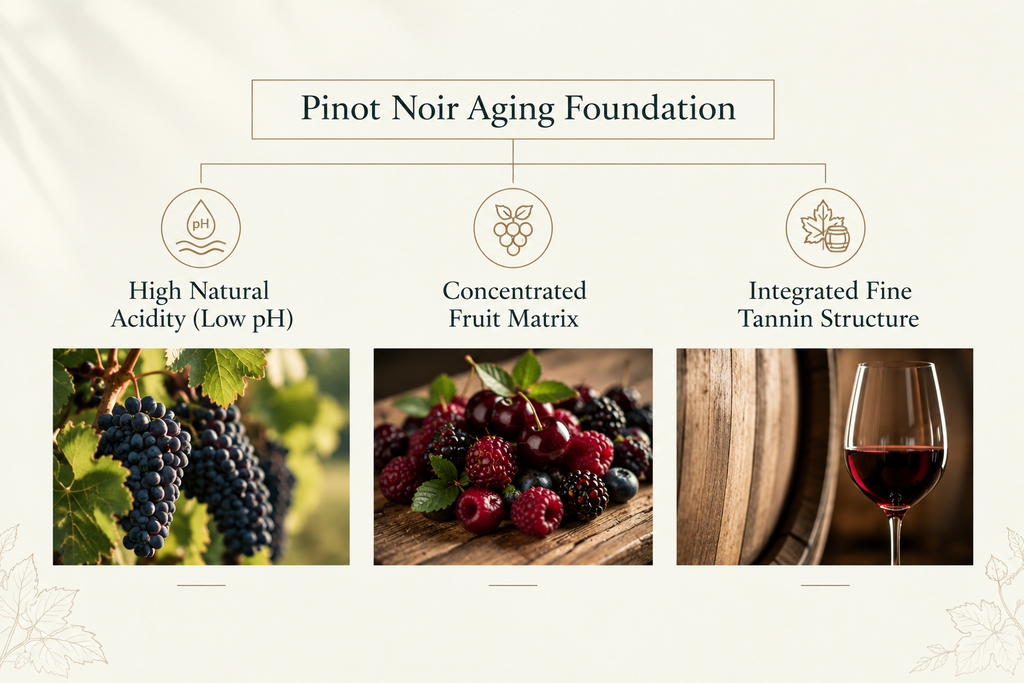
High Natural Acidity (Low pH): While Cabernet Sauvignon and Nebbiolo rely on heavy monomeric tannins for preservation, Pinot Noir relies primarily on natural titratable acidity. Acid acts as the primary preservative engine, protecting the wine against microbial spoilage and oxidation while preserving freshness over decades.
Concentrated Primary Fruit: A wine lacking core fruit concentration will dry out in the bottle. As fresh fruit aromas fade, there must be enough phenolic depth for tertiary characteristics (earth, truffle, forest floor) to emerge.
Integrated Fine Tannin: Coarse, aggressive tannins are a sign of over-extraction or unripeness. Age-worthy Pinot Noir requires fine-grained, silk-like tannins that frame the acidity without overwhelming the palate.
Why Willamette Valley & Dundee Hills Pinot Noir Ages Exceptionally Well
Oregon’s Willamette Valley, and specifically the Dundee Hills AVA, has earned an international reputation for producing cellar-worthy Pinot Noir capable of aging alongside classical Burgundy.
The Role of Cool-Climate Viticulture
During the Pacific Northwest growing season, warm summer days build complex flavor precursors, while cool night breezes from the Van Duzer Corridor preserve natural malic and tartaric acids inside the berries. This natural acid retention prevents the flat, heavy profile common in warmer growing regions.
Jory Volcanic Soils & Mineral Aging
The red, iron-rich Jory volcanic clay soils of the Dundee Hills impart a distinct structural signature. Wines grown in deep Jory clay consistently exhibit fine-grained tannins paired with vibrant natural acidity, providing the structural stamina needed for 10 to 15+ years of bottle maturation.
The Four Phases of Pinot Noir Bottle Evolution
Understanding how Pinot Noir evolves inside the cellar removes the anxiety of guessing when to open a special bottle.
| Phase | Timeframe | Aromatic & Palate Profile | Cellar Recommendation |
| 1. Youthful & Primary | Years 1-3 | Bright cherry, raspberry, red plum, fresh violet, high natural acidity. | Expressive and vibrant. Open now if you prefer fruit-forward energy. |
| 2. The Mute / Awkward Stage | Years 4-6 | Primary fruit recedes; tertiary notes haven’t fully formed. Tannins can feel angular. | Do not open. The wine is mid-conversion; give it time. |
| 3. Peak Harmony (Tertiary Arrival) | Years 7-12 | Dried cherry, forest floor, mushroom, baking spice, damp earth, silky palate. | Optimal drinking window. Maximum complexity and structural balance. |
| 4. Mature Tertiary | Years 12+ | Truffle, leather, dried autumn leaves, game, fully softened acidity. | Enjoy immediately. Best suited for mature Oregon Pinot Noir collectors. |
Applying Coates’ Law of Aging
Renowned Master of Wine Clive Coates established a practical guideline for cellaring fine wine known as Coates’ Law:
“A wine will remain at its peak of drinking pleasure for roughly as long as it took to reach that peak.”
The Practical Implication: If a cellar-selection Pinot Noir requires 7 years of bottle age to reach its full tertiary harmony, it will typically maintain that peak plateau for an additional 7 to 9 years under proper cellar conditions before declining.
This rule means collectors do not need to target a single “perfect date.” You have a multi-year window to enjoy the bottle at its peak.
Optimal Pinot Noir Storage Guidelines
To ensure your bottles reach their full structural potential, adhere to these precise storage parameters:
- Temperature: Keep storage steady at 55°F (13°C). Temperature fluctuations accelerate chemical oxidation, while extreme cold halts maturation.
- Humidity: Maintain 60% to 70% relative humidity to prevent corks from drying out, shrinking, and allowing oxygen ingress.
- Position: Store bottles horizontally to keep the wine in constant contact with the cork, preserving its seal.
- Light & Vibration: Protect bottles from direct sunlight and UV exposure, which break down delicate phenolic compounds, and store away from machinery vibrations. Enology studies from institutions like the UC Davis Department of Viticulture and Enology confirm that UV light exposure prematurely degrades organic sulfur compounds in bottled wine.
Cellar Recommendations from Ambar Estate
At Ambar Estate, our winemaking philosophy focuses on low-intervention techniques, native yeast fermentations, and precise barrel aging designed for long-term longevity. Learn more about how Regenerative Organic Certified® viticulture impacts grape quality and builds natural structural balance.
- Sacra Terra Pinot Noir (Flagship Allocation): Sourced from 11 estate clones across distinct soil-mapped blocks. Built with low pH, vibrant natural acidity, and fine Jory tannins. Cellaring Window: 8 to 12+ years.
- Ambar Estate Pinot Noir: Expressive red fruit core backed by structured acidity and fine-grained French oak integration. Cellaring Window: 5 to 8+ years.
If you are building your personal collection, you can browse our age-worthy estate Pinot Noir releases or explore our minimal-intervention winemaking process.
Frequently Asked Questions
How long can you age Willamette Valley Pinot Noir?
Everyday Pinot Noir ($20-$35) is crafted for consumption within 2 to 3 years. Premium estate-grown Willamette Valley Pinot Noir featuring high natural acidity and structured site characteristics can comfortably develop in the cellar for 10 to 15+ years.
Should you decant an aged Pinot Noir?
Older Pinot Noir (8+ years in bottle) should be decanted carefully and briefly, primarily to separate natural sediment. Excessive decanting can cause delicate tertiary aromatics (dried rose, forest floor) to dissipate rapidly.
What is the “awkward phase” in Pinot Noir aging?
Between years 4 and 6, many structured Pinot Noirs enter a temporary mute phase where primary fruit aromas fade before complex tertiary notes fully develop. If a bottle tastes tight or angular during this time, allow remaining bottles to rest for another 2 to 3 years.