
Walk down any wine aisle, scan a restaurant bottle list, or browse an online store, and you’ll notice labels like Organic, Biodynamic, and increasingly, Regenerative Organic Certified®. While all three terms suggest environmentally responsible farming, their standards, regulatory oversight, and real-world impacts on land and labor differ significantly.
For wine lovers looking beyond marketing claims, understanding the differences can help you make more informed choices about what goes into your glass and what gets invested back into the planet.
At Ambar Estate, located in Oregon’s Dundee Hills AVA, we are proud to be the first Regenerative Organic Certified® (ROC®) Silver winery in the Willamette Valley. But what do these certifications actually measure, and why does the standard matter?
At a Glance: Certification Comparison
| Certification Standard | Synthetic Chemical Ban | Mandatory Annual Soil Testing | Audited Social Equity & Fair Wages | Audited Animal Welfare | Independent Governing Body |
| USDA Organic | Yes | No | No | No | USDA National Organic Program |
| Demeter Biodynamic | Yes | No | No | General Guidance | Demeter USA |
| Regenerative Organic Certified® | Yes | Yes (Measured Metrics) | Yes (In-Person Audits) | Yes (Five Freedoms) | Regenerative Organic Alliance |
1. The Baseline: What USDA Organic Guarantees
The USDA Organic label, established under federal law and enforced by the National Organic Program (NOP), sets the legal floor for sustainable viticulture in the United States.
- What it Guarantees: Zero synthetic pesticides, systemic herbicides (like glyphosate), or synthetic fertilizers used in the vineyard. It also prohibits genetically modified organisms (GMOs) and restricts added synthetic processing aids in the cellar.
- What it Omits: USDA Organic defines what a farm cannot do, rather than what it must improve. It does not require active soil building, erosion control, cover cropping, minimum tillage, animal welfare protections, or fair labor wages.
A vineyard can hold USDA Organic certification while continuously tilling its soil, depleting organic matter, ignoring surrounding biodiversity, and paying minimum wages. The USDA seal tells you what chemicals were kept out of the vineyard, but it tells you nothing about whether the land or community is getting healthier over time.
2. The Ecological Approach: What Biodynamic Adds
Certified primarily by Demeter International and Demeter USA, Biodynamic farming views the vineyard not just as a farm, but as a self-sustaining, living ecosystem.
- What it Requires: Full compliance with organic chemical bans as a baseline, plus holistic ecological practices. This includes reserving a minimum of 10% of total land for wild biodiversity, applying specialized herbal and mineral compost preparations (Preparations 500–507), following a lunar calendar for key farming operations, and relying on native yeast for winery fermentations.
- What it Omits: While Biodynamic viticulture fosters rich microbial life in the topsoil, it does not include mandatory labor standards or audited social equity requirements. Under Demeter rules, a certified biodynamic vineyard can pay harvest crews poverty wages without risking its certification status.
3. The Complete Standard: What Regenerative Organic Certified® Requires
Launched in 2018 by the Regenerative Organic Alliance (ROA), founded by the Rodale Institute, Dr. Bronner’s, and Patagonia, Regenerative Organic Certified® (ROC®) sets a new paradigm. It requires full USDA Organic certification as a prerequisite, then adds three independently audited, non-negotiable pillars:
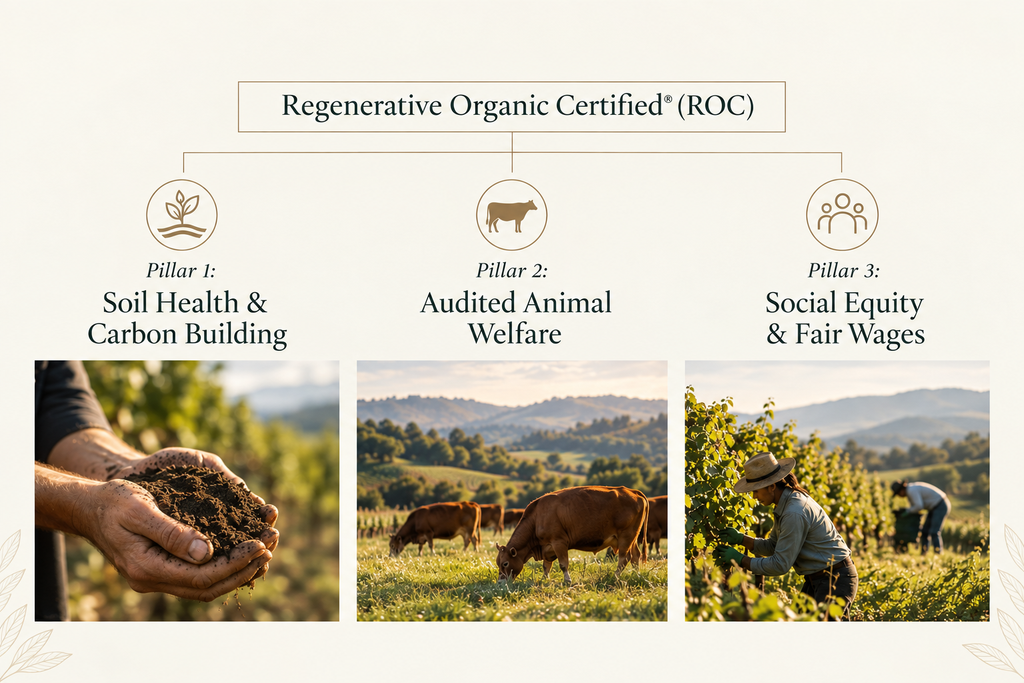
Pillar 1: Measured Soil Health & Carbon Sequestration
While other certifications suggest good farming practices, ROC® mandates annual in-field and triennial laboratory soil testing to measure tangible improvements in soil organic matter year over year.
- Low-to-No-Till Cultivation: Preserves underground mycorrhizal fungal networks and prevents sequestered carbon from oxidizing into the atmosphere.
- Diverse Cover Cropping: Suppresses weeds naturally while drawing atmospheric nitrogen deep into the root zone.
- Targeted Animal Integration: At Ambar Estate, our flock of Shetland sheep grazes our 13-acre vineyard during winter dormant periods. They control cover crop growth and return natural organic matter to the soil without tractor weight that causes soil compaction.
The Science Behind Better Soil: According to research published by the Natural Resources Defense Council (NRDC), every 1% increase in soil organic matter enables an acre of soil to retain up to 20,000 additional gallons of plant-available water. In dry-farmed wine regions like the Dundee Hills, high water retention keeps grapevines balanced during summer heat events without artificial irrigation.
Pillar 2: Audited Animal Welfare
All livestock integrated into an ROC® farm must be managed according to the Five Freedoms standard, originally developed by the UK Farm Animal Welfare Council:
- Freedom from hunger and thirst via ready access to fresh water and balanced diets.
- Freedom from discomfort by providing appropriate shelter and comfortable resting areas.
- Freedom from pain, injury, or disease through prevention and rapid treatment.
- Freedom to express normal behavior with sufficient space and proper facilities.
- Freedom from fear and distress by ensuring conditions that avoid mental suffering.
Pillar 3: Social Equity & Worker Fairness
This is what sets ROC® apart from every other agricultural standard in the world. ROC® requires independent on-site auditing of living wages, safe working conditions, heat protocols, and freedom of association for every worker on the estate. Auditors conduct confidential, in-person employee interviews, not just back-office document reviews.
For wine buyers who care about ethical supply chains, ROC® is currently the only viticultural certification that guarantees human rights alongside land stewardship.
How Soil Biology Shapes the Wine in Your Glass
Great wine is made long before fermentation begins. The health of the living soil directly influences how vine roots explore deep earth layers, how plants build natural immunity against drought and disease, and how fruit achieves optimal acid-to-sugar balance.
Our vineyard sits on deep, classic Jory volcanic clay soils in Oregon’s Dundee Hills AVA. By actively increasing soil biological activity rather than relying on synthetic inputs, our Pinot Noir and Chardonnay vines absorb essential minerals naturally. This subterranean vitality shows up in the glass as vibrant acidity, structural complexity, and distinct regional character.
Our minimal-intervention winemaking approach allows third-party critics to confirm what healthy soil produces:
- 2023 Lustral Chardonnay: 97 Points (International Wine Report)
- 2023 Estate Pinot Noir: 94 Points (Wine Spectator)
- 2021 Sacra Terra Pinot Noir: 97 Points (Wine Enthusiast)
To experience how regenerative viticulture influences flavor depth, texture, and aroma profiles, explore our estate-grown organic wines online.
Experience Regenerative Viticulture Firsthand
Certification is more than a seal on a bottle label, it is an independently verified commitment to leaving the land healthier than we found it.
We invite you to see our winter grazing sheep, native plant hedgerows, and low-input vineyard practices in person. You can reserve an estate tasting experience in the Dundee Hills to sample our current releases paired with local food, or learn more about our vision for sustainable viticulture and how founders Rob and Pam Turner built Ambar Estate from the ground up.
Frequently Asked Questions
How do I verify if a wine is genuinely Regenerative Organic Certified®?
All certified brands, farms, and vineyards are publicly indexed in the official Regenerative Organic Alliance directory. Look for the official ROC® trademark seal (Bronze, Silver, or Gold) on the back of the bottle.
Can a wine be both Biodynamic and ROC® certified?
Yes. A winery can maintain Demeter Biodynamic certification while holding ROC® status. However, Biodynamic certification alone does not satisfy ROC®’s mandatory social equity audits or annual soil carbon testing requirements.
Why are there so few ROC® certified wineries?
The standard is rigorous. A vineyard must first earn USDA Organic status, then complete independent audits across soil metrics, animal welfare, and labor conditions every year. Ambar Estate is currently the first and only ROC® Silver certified vineyard in Oregon’s Willamette Valley.
Does regenerative farming improve wine aging potential?
Yes. Grapes grown in living, microbially diverse soils typically feature higher natural acidity, balanced sugar accumulation, and robust phenolic structures, all key components for long-term cellaring.