
Walk into a tasting room or scan a collector’s cellar sheet, and you’ll frequently see bottles listed simply as “100% Pinot Noir.” Yet, pour two estate Pinot Noirs grown on the exact same hillside side-by-side, and one might burst with vibrant red florals and high-toned spice, while the other exhibits dark plum, forest floor, and dense, muscle-bound tannins.
The secret behind this dramatic difference often comes down to clonal selection.
Because Pinot Noir (Vitis vinifera) is one of the oldest cultivated wine grapes on Earth, its genetic code is famously unstable. Over centuries of cultivation, individual vines underwent subtle, natural mutations, altering berry size, skin thickness, cluster compactness, and aromatic compound synthesis.
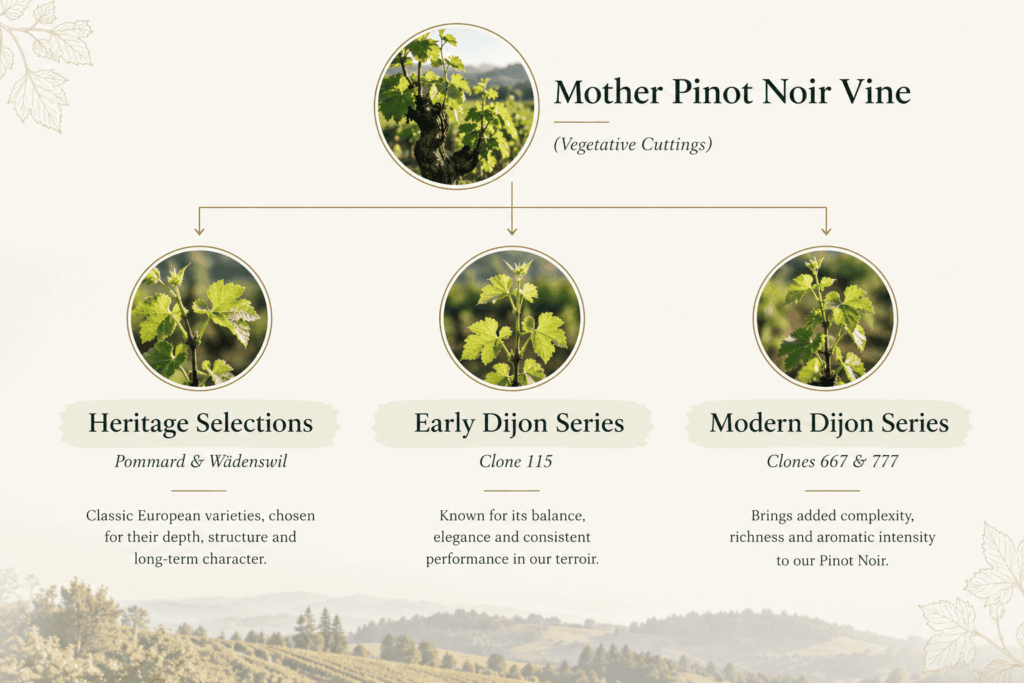
Understanding the differences between Heritage clones (Pommard and Wädenswil) and French Dijon clones (115, 667, and 777) reveals how viticulturists and winemakers craft complex, cellar-worthy wines.
What Is a Pinot Noir Clone?
A grape clone is a precise genetic copy of a single mother vine, propagated through cuttings rather than seeds.
When a vine grower identifies a specific plant demonstrating exceptional qualities, such as smaller berries, enhanced disease resistance, or higher natural acidity, they take cuttings from that vine to cultivate identical progeny.
In cool-climate growing regions like Oregon’s Willamette Valley, clonal choice dictates not just how a wine tastes, but how its grapes ripen, manage moisture, and retain acidity through late summer harvest.
The History: How Clones Reshaped Oregon Pinot Noir
When Oregon’s wine pioneers first planted vines in the late 1960s and early 1970s, their choices were limited to cuttings brought up from California propagation nurseries:
Wädenswil (Clone UCD 1A/2A): Imported from Switzerland to UC Davis by Dr. Harold Olmo in 1952, this clone thrived in cool, damp conditions due to its loose cluster formation.
Pommard (Clone UCD 4): Sourced from France’s Château de Pommard in the Côte de Beaune, this selection brought much-needed body, deep red fruit, and muscular tannic weight.
By the mid-1980s, Oregon viticulturists, led by David Adelsheim in partnership with Dr. Raymond Bernard of the University of Dijon and Oregon State University, brought certified Burgundian selections through U.S. quarantine. These cuttings, labeled by their Burgundian nursery numbers, arrived in 1987 and 1988 and became universally known as the Dijon clones.
Heritage Clones: The Structural Backbone
Heritage clones form the foundation of classic Oregon Pinot Noir, celebrated for their longevity, open canopy structures, and complex savory nuances.
| Clone Selection | Historical Origin | Cluster & Berry Morphology | Typical Flavor & Aromatic Profile | Structural Contribution |
| Pommard (UCD 4) | Côte de Beaune, Burgundy | Moderately compact; medium-to-large berries. | Dark cherry, pomegranate, dried herbs, game, black tea, and damp earth. | Muscular & Age-Worthy: Provides deep mid-palate density, rich umami, and firm structural tannins. |
| Wädenswil (UCD 1A/2A) | Wädenswil, Switzerland | Large, loose clusters; small-to-medium berries. | Cranberry, tart red plum, white pepper, cinnamon, lifted rose petal. | High Acidity & Lift: Offers vibrant tartaric acidity, bright spice top-notes, and elegance in cooler vintages. |
The Role of Pommard & Wädenswil in the Cellar
Pommard brings an “old soul” depth to a bottle. Because its berries develop thicker skins relative to juice volume, it yields higher phenolic extraction, giving the resulting wine the tannic framework required to cellar past decade one.
Wädenswil acts as an aromatic lift, maintaining bright natural acidity even during warmer growing seasons.
The French Dijon Trio: Aromatic Precision & Focus
Introduced to North America to excel in cool growing seasons, Dijon clones ripen slightly earlier than Heritage selections, producing small, concentrated berries with intense aromatic clarity.
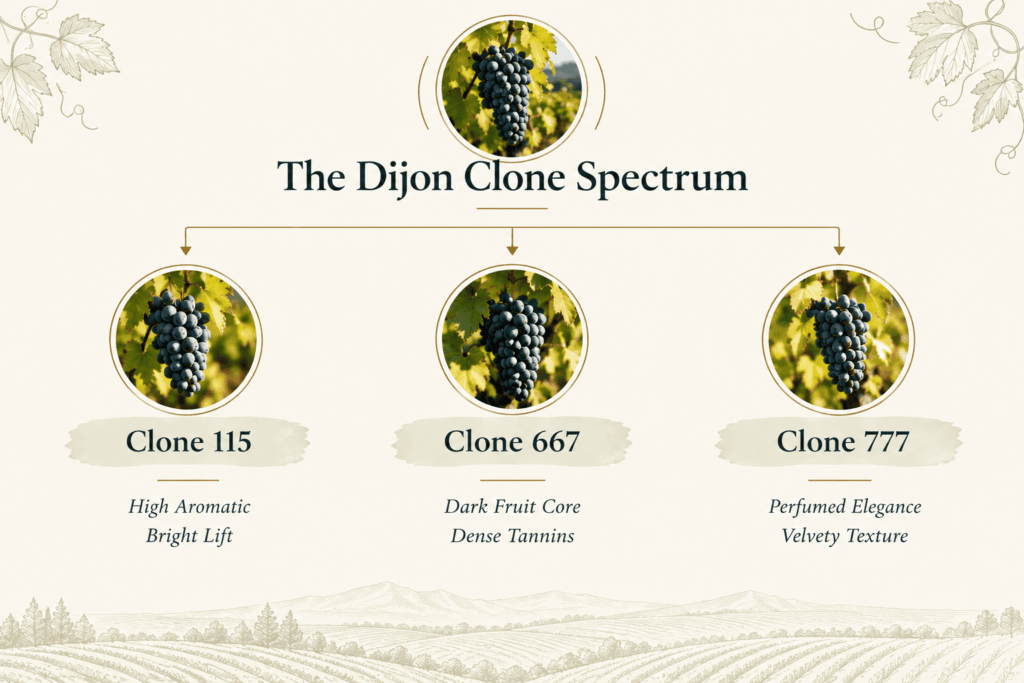
1. Dijon Clone 115: The Elegant Anchor
- Aromatic Profile: Bright red raspberry, wild strawberry, red floral top notes, subtle baking spice.
- Viticultural Trait: Early ripening with exceptional balance between sugar accumulation and acid retention.
- In the Glass: Known as the “complete” clone, 115 offers a pure, fruit-forward expression with fine-grained tannins and radiant red-fruit energy.
2. Dijon Clone 667: The Dark & Structured Engine
- Aromatic Profile: Black raspberry, dark brambleberry, forest floor, savory herbs, dark cocoa.
- Viticultural Trait: Small, tightly packed clusters that demand careful canopy management to ensure air circulation.
- In the Glass: Clone 667 contributes deep color extraction, mid-palate weight, and firm, persistent tannins that form the structural core of premium red wines.
3. Dijon Clone 777: The Aromatic Powerhouse
- Aromatic Profile: Blackberry, violet, rose petal, exotic Asian spice, dark plum
- Viticultural Trait: Low yields with very small berries, creating a high skin-to-juice ratio.
- In the Glass: Highly prized for single-clone bottlings, 777 brings exotic aromatics, opulent fruit concentration, and a velvety, polished mouthfeel.
Terroir Synergy: Clones in Dundee Hills Jory Soil
A clone does not exist in a vacuum; its ultimate expression depends on where its roots draw nutrients.
In Oregon’s Dundee Hills AVA, the defining soil characteristic is Jory volcanic clay, a deep, iron-rich red soil formed by ancient basalt lava flows.
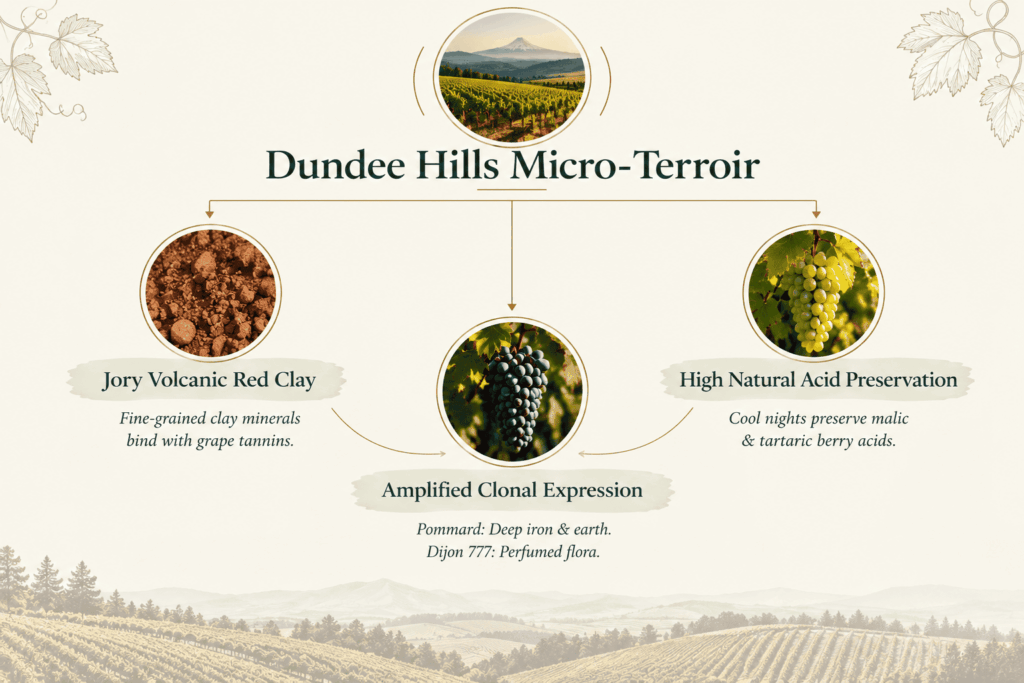
How Jory Soil Elevates Pommard: The iron-rich clay binds with Pommard’s robust tannin structure, transforming potentially harsh tannins into smooth, mineral-driven cocoa and savory earth notes.
How Cool Elevations Modulate Dijon 777: Grown on southeast-facing slopes between 500 and 800 feet, Clone 777 retains its bright tartaric acid balance, preventing its lush fruit from becoming overly heavy or flabby.
To learn more about how living soil ecology impacts grape balance, read our guide on how Regenerative Organic Certified® viticulture shapes wine quality.
Single-Clone Bottling vs. Multi-Clone Estate Blends
Winemakers approach clonal selection much like an artist approaches a palette:
The Single-Clone Bottling
Highlighting a single block planted to one specific clone (such as a 100% Pommard or 100% Dijon 777 release) offers an unblended, pure study in genetic character. Collectors favor single-clone releases to experience the singular expression of an isolated vine selection on a specific plot of land.
The Blended Estate Allocation
In flagship estate wines, such as our Sacra Terra Pinot Noir, the goal is complete harmony. By fermenting individual vineyard blocks separately and blending them prior to barrel aging, winemakers layer the strengths of multiple clones:
- Top Notes: Dijon 115 and 777 provide fragrant violet aromatics and red-fruit brightness.
- Mid-Palate Density: Dijon 667 adds plush blackberry fruit and mid-palate weight.
- Finish & Cellar Stamina: Pommard and Wädenswil contribute muscular tannic architecture, long-term acidity, and earthy length.
Enology research from institutions like the UC Davis Department of Viticulture and Enology shows that managing clone-specific phenolic extraction significantly improves both color stability and long-term aging potential.
If you are expanding your cellar, explore our current age-worthy estate Pinot Noir releases or dive into our minimal-intervention winemaking philosophy.
Frequently Asked Questions
What is the main difference between Pommard and Dijon Pinot Noir clones?
Pommard is a Heritage clone from Burgundy known for larger berries, darker fruit profiles (black cherry, plum), savory earthiness, and firm structural tannins. Dijon clones (such as 115, 667, and 777) are French selections developed for smaller berry sizes, earlier ripening, bright floral aromatics, and focused fruit intensity.
Why do winemakers blend different Pinot Noir clones together?
Blending different clones allows winemakers to build a more complex and complete wine. One clone may provide bright floral aromatics (Dijon 115), another brings dense mid-palate dark fruit (Dijon 667), and a third adds structural tannins and aging potential (Pommard).
Which Pinot Noir clone ages the longest in a wine cellar?
Heritage clones like Pommard generally possess the thickest skins and highest concentration of structural tannins, making them exceptional candidates for 10 to 15+ years of cellar aging. However, Dijon clones planted in high-acid, cool-climate sites like the Dundee Hills also age exceptionally well when properly cellared at 55°F.