
There is a distinct sensation as you wind your way up the slopes of the Dundee Hills. The thick fog of the valley floor gives way to sharp, clear sunlight. The air takes on a forest-lined crispness, and the vibrant red, iron-rich Jory soil opens up into rolling hillside blocks.
It is no coincidence that the world’s most celebrated Pinot Noirs are rarely grown on flat valley floors. In viticulture, topography is destiny. But why does elevation matter in wine, and specifically, how does altitude shape the balance, structure, and elegance of Dundee Hills Pinot Noir?
To understand what lands in your glass, we have to look at what happens at the vine: where altitude, sunlight, air movement, and living soil meet.
The Science of Altitude: Why Slope Elevation Matters in Viticulture
Pinot Noir is a notoriously sensitive variety. Unlike thick-skinned, heat-loving grapes like Cabernet Sauvignon or Syrah, Pinot Noir has thin skins and a delicate balance of natural sugars and acids. It demands very specific Oregon Pinot Noir growing conditions to thrive without losing its fresh, aromatic focus.
As you ascend through the Dundee Hills, ranging from roughly 200 feet above sea level to over 1,000 feet, the ambient climate changes noticeably. In atmospheric science, the temperature drops approximately 3.5°F for every 1,000 feet of elevation gained (a phenomenon known as the lapse rate).
When pioneers first realized the potential of cool-climate viticulture here, they recognized that hillside slopes offered the ideal temperate zone for slow, balanced ripening. If you’re curious about how those early plantings reshaped global perception, explore the story of how the Willamette Valley became a world-class wine region.
Thermal Inversion & The Diurnal Shift: Preserving Bright Acidity
In winegrowing, elevation alters air movement just as much as ambient temperature. Understanding two critical meteorological dynamics on hillside blocks explains why altitude translates into wine purity:
1. Thermal Inversion and Cold-Air Drainage
During cold spring nights, heavy, cold air naturally drains downhill into the valley basins like a dense liquid. On mid-to-high hillside slopes, warm air hovers overhead, creating a protective “thermal belt.” This constant cold-air drainage shields high-elevation vines from damaging spring frosts and prevents stagnant, humid air pockets from forming around the canopy.
2. The Diurnal Shift
The difference between daytime warmth and nighttime coolness, known as the diurnal shift, is accentuated on high-elevation slopes.
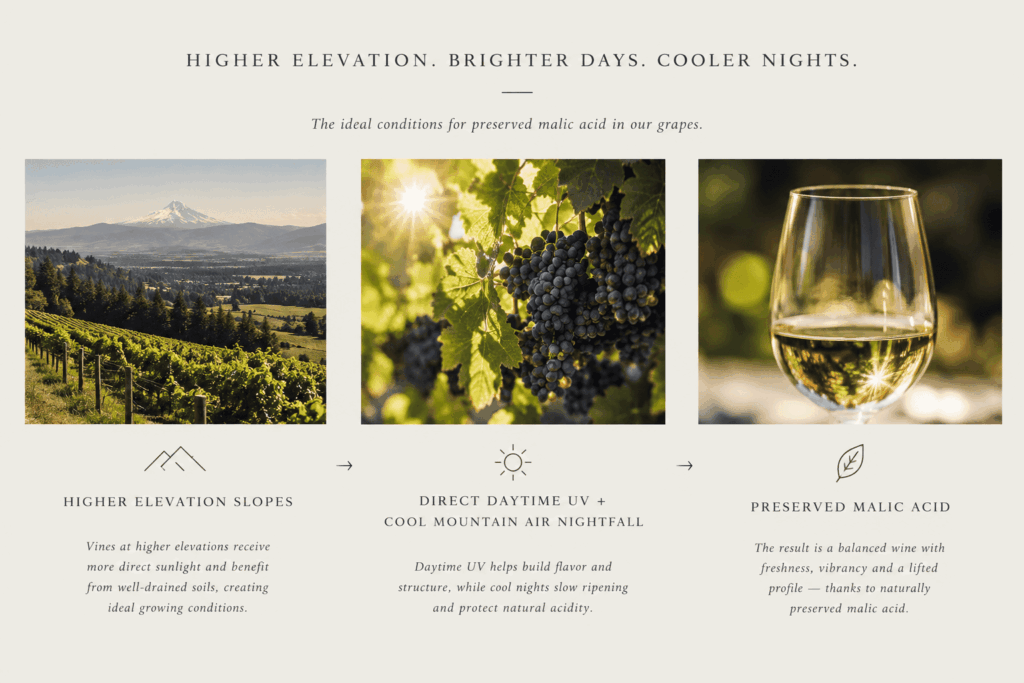
- Daytime: Direct, unbroken sunlight above the valley line warms the clusters, allowing complex berry flavors to develop naturally.
- Nighttime: Cool breezes sweeping down from the Coast Range cause temperatures to plummet at nightfall.
This nighttime drop pauses sugar accumulation and locks in natural tartaric and malic acids. The result is a high-elevation Pinot Noir from Oregon that delivers rich fruit concentration seamlessly balanced by bright, mouthwatering acidity.
UV Light Intensity: Skin Thickness, Tannins, and Color Extraction
One of the most overlooked aspects of how elevation affects wine is the quality and intensity of sunlight.
At higher altitudes, the atmosphere is thinner, allowing greater direct ultraviolet (UV) radiation to reach the vineyard canopy. Vines respond to UV exposure through natural biological defense mechanisms: the grapes grow slightly thicker skins and produce higher levels of polyphenols and anthocyanins (natural antioxidants and color compounds).
Because a red wine’s color, tannic structure, and aromatic complexity come entirely from its skins, this elevation shift directly elevates the final wine:
| Elevation Variable | Impact on Grape Biology | Result in the Glass |
| Increased UV Radiation | Thicker grape skins & polyphenols | Richer natural color, deeper complexity, silky tannins |
| Cooler Ambient Air | Slow, extended sugar accumulation | Balanced alcohol levels and crisp aromatic focus |
| Nighttime Cool Air Drainage | Acid retention in the pulp | Electric, refreshing natural acidity and longevity |
Skin thickness and UV adaptation also interact closely with vine genetics. To see how different vine selections handle these microclimates, read our guide on how different Pinot Noir clones perform on hillside blocks.
Drainage, Root Depth, and Soil Interaction on Slopes
The story of Dundee Hills elevation wine is inextricably tied to what lies beneath the surface: volcanic Jory soil.
On flat valley bottoms, soils tend to be deeper, heavier, and prone to retaining excess water. Vineyards planted on low, flat terrain often experience over-vigorous canopy growth, where vines channel their energy into growing leaves rather than concentrating fruit flavors.
Elevation on hillside slopes changes this dynamic completely:
- Natural Water Drainage: Rainwater glides down the slope, keeping roots from sitting in saturated ground.
- Deep Root Architecture: To find moisture during dry late-summer weeks, roots must push 4 to 6 feet down through fractures in ancient volcanic basalt.
- Harmonious Stress: Mild, natural water stress limits excessive canopy growth, allowing the vine to focus its energy on ripening smaller, flavor-dense clusters.
At Ambar Estate, this hillside geology works hand-in-hand with our Regenerative Organic Certified® practices. By maintaining multi-species cover crops to keep hillside soils cool and bringing sheep into the vineyard during winter to graze and fertilize naturally, we build living, biologically active soil that translates pure Dundee Hills terroir straight into the vine.
In the Glass: What High-Elevation Dundee Hills Pinot Noir Tastes Like
When altitude, volcanic soils, and low-intervention winemaking align, the profile in your glass is unmistakable.
A high-elevation Willamette Valley Pinot Noir from the Dundee Hills offers a masterclass in elegance and restraint:
- Aromatics: Lifted, expressive notes of fresh wild strawberry, tart cherry, and pomegranate, framed by high-toned rose petal, violet, and subtle forest floor spice.
- Palate & Structure: Vibrant, electric acidity underpins a refined mid-palate, with fine-grained, silky tannins that carry the wine smoothly across the finish.
- Cellar Potential: Thanks to the natural acid preservation and polyphenol structure achieved on elevated slopes, these wines possess remarkable aging potential, developing tertiary nuances over 10 to 15+ years.
Ready to taste the difference elevation makes? You can explore our estate-grown Dundee Hills Pinot Noir collection to see how these hillside blocks express themselves across our releases.
Experience High-Elevation Viticulture at Ambar Estate
Farming high-elevation slopes requires patience, precision, and respect for the land. As the first Regenerative Organic Certified® vineyard in the Willamette Valley, Ambar Estate is dedicated to showcasing the authentic character of our Dundee Hills site, from our dry-farmed vines to our minimal-intervention cellaring.
The best way to understand hillside viticulture is to walk the red dirt yourself. We invite you to plan a visit to our Dundee Hills tasting room to experience our estate wines, take in the panoramic views of the valley, and discover what makes high-elevation Dundee Hills Pinot Noir truly world-class.
Frequently Asked Questions
How does elevation affect Pinot Noir taste and quality?
Higher elevation exposes vines to intense UV light and cooler temperatures, resulting in grapes with thicker skins and preserved natural acidity. This yields a Pinot Noir with richer color, deeper aromatic complexity, silky tannins, and exceptional balance compared to valley-floor wines.
Why are Pinot Noir vineyards planted on slopes rather than valley floors?
Hillside slopes provide natural water drainage and prevent cold air from settling around the vines. Nighttime cold air drains down into the valley, protecting high-elevation hillside blocks from spring frost while forcing grape roots deep into nutrient-rich volcanic soil.
What is thermal inversion in viticulture?
Thermal inversion occurs when cold, heavy air slides downhill into valley basins at night, leaving a warm air “belt” on mid-to-high slopes. This protects high-elevation grapes from severe frost and allows steady, gentle ripening without excessive heat.
How does elevation affect alcohol levels in wine?
Cooler average temperatures at higher altitudes slow down sugar production in the grape pulp. Lower sugar levels at harvest result in moderate natural alcohol levels, keeping the wine balanced, fresh, and acid-driven rather than hot or heavy.
What flavors are typical of high-elevation Dundee Hills Pinot Noir?
High-elevation Dundee Hills Pinot Noir typically exhibits lifted aromatics of tart cherry, wild raspberry, and violet, backed by subtle forest floor spice, vibrant natural acidity, and fine-grained, age-worthy tannins.