
Ask anyone to name a famous Willamette Valley wine, and Pinot Noir is usually the first answer.
That’s the right answer, but it’s not the whole picture anymore.
Changes are happening in the Dundee Hills, starting with Chardonnay. The same volcanic soils, cool climate, and Pacific maritime influence that made Oregon’s Pinot Noir famous are now creating a white wine story that the wine world is beginning to recognize.
Wine Spectator stated it clearly: “Willamette Valley has made its reputation on Pinot Noir. But its Chardonnay is proving to be equally exciting.
This change is not random. In the Dundee Hills, it has been building for longer than most people think.
Key Takeaways
The Willamette Valley Chardonnay story is no longer emerging. It has arrived.
- VinePair named the Willamette Valley one of the world’s top Chardonnay regions in 2025, praising wines ranging from “mineral and bright to rich and savory”
- In 2026, an Oregon Chardonnay beat French wines in a blind tasting. The second time in history American wine has done this, after the Judgment of Paris in 1976
- Five Oregon Chardonnays made VinePair’s Top 50 Wines of 2025
- The first Oregon wine to ever earn a perfect 100-point score from Decanter was a Willamette Valley Chardonnay, the 2023 High Wire from Bethel Heights Vineyard
- Ambar Estate’s Lustral Chardonnay earned 97 points from the International Wine Report and 95 points, Editors’ Choice, from Wine Enthusiast, from a tasting room that only opened in 2024
Beyond Pinot Noir: Why Chardonnay Is Having Its Moment in Oregon
Chardonnay has always been part of the Willamette Valley. What changed in this region was the attitude toward it, which is the subject of conversation today.
For decades, winemakers in Oregon have struggled with the legacy of the “ABC curse” (Anything But Chardonnay), as it was called in the trade. California made Chardonnay famous for middle-aged people who grew up thinking about wine in terms of heavily oaked, buttery California versions. Meanwhile, a cool climate was completely unsuitable for growing the same grape varietals.
As stated in the article by Wine Advocate in 2024, “As American palates continue to evolve towards a preference for more refreshing and less overtly oaked styles, Willamette Valley Chardonnay offers promise as a versatile, high-quality value.”
This promise has come true. Today, Chardonnay is no longer an empty canvas, but the region has managed to create its school, in which acidity, minerality, and restraint predominate.
In 2026, a blind tasting will be held comparing the wines of America and France, which will also be significant for Oregon’s wine industry. The local winery Flâneur Wines, based in Carlton, has been invited to participate again. In 2021, its Bon Vivant Chardonnay won the top prize in the same competition, which is seen as the local equivalent of the Judgment of Paris of 1976. This happened 50 years later, and this time it was white against white.
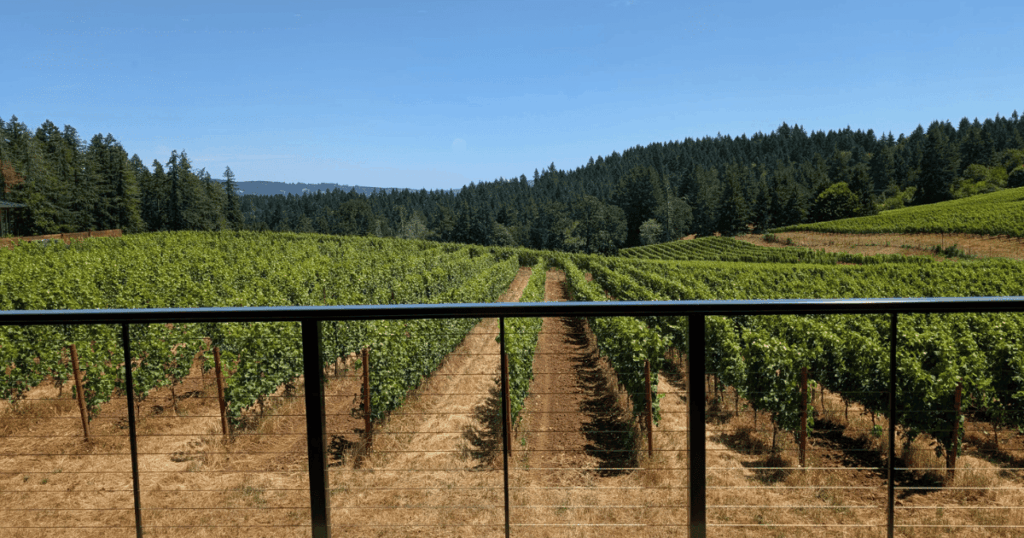
Why the Willamette Valley Is So Well Suited to Chardonnay
The same factors that made the Willamette Valley a great location for growing Pinot Noir also contribute to the growing region’s ability to produce outstanding Chardonnay, but with one important difference.
While Pinot Noir requires cool temperatures and a long growing season to produce flavorful yet light-bodied wines, Chardonnay needs the same cool evenings and warm days, plus the natural acidity provided by warm climates that are harvested before the heat has leached the acid out of the grapes.
The Willamette’s 45th parallel, maritime touch from the Pacific, and long growing season all contribute to letting the wine gain complexity while retaining the natural acidity that gives Chardonnay its characteristic zip. The Week noted that the region’s “cool nights and warm summer days” help to produce wines with “flavorful yet light-bodied” characteristics.
Chardonnay from The Willamette does not have the “rich, broad flavors” of its California counterpart, says the article, because it “was never intended to be.”
The Week noted that the region’s cool nights and warm summer days contribute to the production of wines with “flavorful yet light-bodied” characteristics. This is the same reason why the region’s Chardonnay does not possess the “rich, broad flavors” of its California counterpart, says the article – because it “was never intended to be.”
Why Dundee Hills Could Be Chardonnay’s Next Great Frontier
Within the Willamette Valley, the Dundee Hills AVA occupies a specific and significant position.
The rise of Willamette Valley Chardonnay is largely credited to growers’ decision to plant Dijon clones, originally sourced directly from Burgundy’s Côte d’Or, where Chardonnay reached its most celebrated expression. The Dundee Hills, with its Jory volcanic clay and east-facing slopes, proved a natural home for those clones.
The key numbers: Chardonnay represents approximately 5.75% of the Dundee Hills’ total planted acreage compared with 69.5% for Pinot Noir. That proportion matters. Chardonnay here is not a commodity, it’s a considered choice by producers who believe this specific terroir has something to say in white.
The Dundee Hills isn’t trying to become Burgundy. It is developing its own voice, mineral-driven, site-specific, shaped by volcanic soil and Pacific maritime air. That distinction is the entire point.
Wine Economist described a Dundee Hills Chardonnay as a wine that “forced us to rethink what we thought we knew about Chardonnay in Oregon, this wine, more than most, is about place.”
That is exactly the conversation the Dundee Hills is ready to have.
What Does Dundee Hills Chardonnay Actually Taste Like?
The profile of the best Dundee Hills Chardonnay is usually one of finesse rather than power.
Look for flavors of citrus, lemon, green apple, and fresh pear, with an almost minerally quality from the iron-rich Jory clay.
The wine has texture without being heavy, the result of natural alcohol extracted from the fruit rather than from oak. Acidity is the key to varietal Chardonnay, providing freshness on the palate and allowing the wine to age gracefully.
Wine made from Chardonnay grapes should be fermented in oak barrels to add body and complexity.
VinePair praised the Willamette Valley Chardonnay for its “distinct expressions ranging from mineral and bright to rich and savory”, the full spectrum that this region has to offer in the realm of white wines.
What Makes a Chardonnay One of the Best?
The question is worth asking honestly, because “best” in wine is not the same as “most expensive” or “most awarded.”
The best Chardonnay wine is one that tells you clearly where it’s from, where it’s going, and why someone made it the way they did. That means:
Balance — acidity, fruit, and structure in proportion, not in competition
Acidity — the structural engine that drives aging and keeps the wine fresh
Concentration — a function of yield, clone selection, and site, not of extraction
Restraint in oak — the wood should add dimension, not flavor
A sense of place — the wine should taste like it couldn’t have come from anywhere else
The 2023 High Wire Chardonnay from Bethel Heights Vineyard earned a perfect 100-point score from Decanter, the first Oregon wine of any variety ever to receive that distinction from the publication. It is a Willamette Valley Chardonnay. That should tell you something about what this region is capable of.
Estate-Grown Chardonnay: Why Vineyard Control Changes Everything
Not all Willamette Valley Chardonnays are created equal, and the big difference starts in the vineyards.
VinePair named the category’s best producers as those creating “deeply compelling wines helped in part by a more contemporary approach,” but the contemporary approach starts from below the vines.
By using estate-grown fruit, a winemaker can dictate clone selection, harvest timing, irrigation technique, and more from the moment the shoot is first pruned to the moment the fruit is harvested and pressed.
All of Ambar Estate’s chardonnays are made exclusively from the fruit grown on our 13-acre estate on the Worden Hill Road.
We did a sonar soil analysis before planting a single vine, and we selected three different Chardonnay clones to plant across our property based on their individual compatibility with the specific blocks’ drainage capacity and depth. We have never purchased any fruit, and we never will.
For the full story on why estate control matters: Decoding Estate Grown: Why Your Best Chardonnay Wine Starts With Soil Control
Does Soil Really Change Chardonnay?
Soil is not magic. But it is a genuine variable in how a vine grows and how a wine tastes.
Jory volcanic clay, the iron-rich, well-drained soil that covers the Dundee Hills above 330 feet of elevation, has two properties that matter specifically for Chardonnay. First, it is naturally low in fertility, which forces the vine to work for its fruit, producing smaller, more concentrated clusters. Second, its clay-rich subsoil holds winter moisture through Oregon’s dry summer, allowing dry farming without irrigation and the natural acidity that comes with a controlled, unhurried ripening season.
The result is Chardonnay that doesn’t need to be corrected. The acidity is there. The concentration is there. The mineral character is in the fruit, not added later.
One thing is worth saying clearly: soil doesn’t automatically make better wine. It creates conditions. What the farmer and winemaker do within those conditions decides everything else.
Chardonnay vs. Pinot Noir: The Two Faces of the Willamette Valley
| Pinot Noir | Chardonnay | |
| Fruit | Red cherry, raspberry, wild strawberry | Citrus, green apple, orchard fruit |
| Structure | Fine, silky tannin | Bright, sustained acidity |
| Texture | Soft, layered | Precise, mineral-driven |
| Character | Earth, spice, forest floor | Stone, chalk, subtle oak |
| Aging | Acidity carries longevity | Acidity carries longevity |
Both varieties share the same structural advantage from the Dundee Hills’ cool climate and Jory soil. But they express that advantage differently, Pinot Noir through texture and depth, Chardonnay through precision and tension.
They are not competing. They are complementary arguments made by the same hillside.
Read more: Willamette Valley Pinot Noir vs. Chardonnay
Why the Future of Willamette Valley Wine May Be More Diverse
The Oregon Chardonnay Celebration 2025 sold out; nearly 400 attendees sampled wines from 61 participating wineries. The event was founded specifically to change the narrative that Oregon can’t grow Chardonnay. That narrative is now being retired.
The Wine Economist wrote in July 2026 that “Chardonnay is the Oregon pivot worth noting”, driven by a recognition that white wine sales are holding up better than red, and that Willamette Valley Chardonnay offers both quality and compelling regional identity.
This is not Pinot Noir being replaced. It is a region discovering the full breadth of what its terroir can say. The Willamette Valley’s next chapter is not a narrower story, it’s a wider one.
The Dundee Hills has already written four consecutive DWWA Best in Show titles in Pinot Noir. The Chardonnay chapter is being written now.
How to Find the Best Chardonnay Wine From the Willamette Valley
A practical guide for any buyer:
Look for a specific AVA. Dundee Hills, Chehalem Mountains, Ribbon Ridge, these are distinct sub-appellations with distinct terroir signatures. Regional specificity is a quality signal.
Find estate-grown fruit. Named vineyard blocks, small production, a single source of grapes- these are signs the winemaker has genuine control.
Consider the oak approach. Barrel-fermented doesn’t mean over-oaked. Ask whether the oak is serving the terroir or masking it.
Pay attention to acidity. Great Willamette Valley Chardonnay should make your mouth water. If it feels fat and soft with no lift, the acidity is missing.
Research the farming. Organic, regenerative, LIVE-certified these certifications verify that someone is paying close attention to the ground the wine came from.
Why Ambar Estate’s Dundee Hills Chardonnay Belongs in the Conversation
We did not come to Chardonnay as an afterthought. We came to it because the same Jory clay, the same east-facing slopes, and the same regenerative farming practices that shape our Pinot Noir have something different and equally compelling to say in white.
2023 Lustral Chardonnay — A barrel selection from across the estate. 97 points, International Wine Report. 95 points, Editors’ Choice, Wine Enthusiast. Opulent and precise — the balance of finesse and richness that defines what Dundee Hills Chardonnay can become.
2023 Estate Chardonnay — The everyday expression of the same vineyard. Elegant acidity, bright aromatics, and the mineral character that Jory clay gives every vintage. The bottle for opening tonight.
2023 Minera Chardonnay — Concrete-fermented, from our Writer’s Block and Maple Block. Asian pear, makrut lime, flinty minerality, the most unmediated expression of this site we make. Reserved for the Ambar Circle by design.
Frequently Asked Questions
Is Willamette Valley Chardonnay good?
Yes, and in 2025-2026 the evidence is hard to argue with. A Willamette Valley Chardonnay earned the first-ever perfect 100-point Decanter score given to any Oregon wine. Five Oregon Chardonnays appeared in VinePair’s Top 50 of 2025. An Oregon Chardonnay beat French wines in a blind tasting in 2026.
What does Willamette Valley Chardonnay taste like?
Brighter and more mineral-driven than California Chardonnay. Expect citrus, green apple, orchard fruit, and a stony minerality underpinned by fresh natural acidity. Oak, when present, adds texture rather than flavor.
What makes Dundee Hills Chardonnay different from other Oregon Chardonnay?
The Dundee Hills’ volcanic Jory clay soil gives Chardonnay a specific mineral character, iron-driven, precise, and site-specific. Combined with the AVA’s east-facing slopes and cool maritime climate, it produces Chardonnay with tension and elegance rather than richness and weight.
Is Oregon Chardonnay similar to Burgundy?
In structure, yes, both share bright acidity, cool-climate fruit, and mineral character. But Dundee Hills Chardonnay is developing its own identity rather than mimicking Burgundy. The volcanic soil gives it a different mineral profile from Burgundy’s limestone-based terroir.
What price range is worth buying for Willamette Valley Chardonnay?
At $65-75 for estate-grown fruit from a serious producer, you can find genuinely compelling Chardonnay. The flagship expressions, single-vineyard or barrel-selection wines, typically run $90-120 and reflect a more complex, age-worthy profile.